Past Exhibitions


Eames: An Exploration of Modern Design

November 18, 2007- June 22, 2008
Discovery Gallery

The Museum’s new Discovery Gallery installation highlights 20th century design through the examination of a molded plywood dining chair designed by Charles and Ray Eames. This exploration of design represents the first time the Discovery Gallery has delved into this complex and important concept.  The exhibition offers viewers a chance to learn about two of the iconic designers of the modern era and exercise their own creative skills to develop their own chair design. Visitors will also be able to sit in various chair models and vote for their favorite design. Reference books focusing on the Eameses and other leading designers will be available in the gallery.

In the early 1940s, husband-and-wife designers Charles and Ray Eames began to experiment with molded plywood, or wood that is shaped using heat and pressure. Their technological innovations led to a contract from the U.S. military in 1942 to develop plywood splints and stretchers. After World War II, the Eameses modified their production to create inexpensive, high-quality chairs that sparked a whole new look in furniture design. Their products featured a functional, modern aesthetic which was surprisingly comfortable. In 1946, the Eameses established their long and legendary relationship with Herman Miller, who made and mass-marketed the Eames molded plywood chair. This chair design continues to be a fresh and modern design, as inspiring to designers today as it was 60 years ago.

This exhibition is made possible by the generous support of Hecht Burdeshaw Architects, Inc

The Objects of Our Desires: Collectors and Collections in the Chattahoochee Valley
January 27 – May 4
Shorter and Leebern Galleries

This exhibition explores the fascinating world of collecting by showcasing a wide variety of intriguing local collections of art and historical objects. These wide-ranging collections, many with rare objects and several on public display in Columbus for the first time, each tell a unique story. Objects of My Desire will highlight the ways collections are assembled and what they mean to the collectors who care for them. In addition, the exhibition will explore the ways collectors and museums work together to make private collections important cultural resources for the larger community.

This exhibition is made possible by the generous support of The Norman S. & Emmy Lou P. Illges Foundation

Painters of American Life: The Eight
December 8, 2007 – February 17, 2008

Painters of American Life: The Eight celebrates the anniversary of the famous 1908 exhibition at Macbeth Galleries in New York by the radical group The Eight.  The exhibition will include representative work by all members of the group: Arthur B. Davies, William Glackens, Robert Henri, Ernest Lawson, George Luks, Maurice Prendergast, Everett Shinn, and John Sloan.  Chronologically, the exhibition features works by these artists that date from circa 1908 as well as the decades before and after.  The exhibition thus casts new light on this group within the larger context of American modernism.  The exhibition is organized by Cheekwood Botanical Garden and Museum of Art in Nashville, Tennessee and includes two works from the Columbus Museum’s permanent collection.  Columbus Museum is one of five venues throughout the Southeast to host the exhibition.
 
One hundred years ago, eight American artists decided to break new ground and exhibit their work free from the constraints of the National Academy of Design.  Artistically, the Eight were a diverse group of artists, pursuing different modes of modern art.  Henri, Glackens, Luks, Shinn, and Sloan, all were urban realists who later were labeled as the “Ashcan School” because of their subject matter.  In many ways, the group only cohered in asserting independence from an institution that they considered too conservative, namely the National Academy.  Despite their fleeting group-identity, the Eight created something that would be a model for future generations of artists: the idea of an artistic event and related media buzz.   The Eight set a precedent for many independent group exhibitions that followed in the twentieth century, including the famous 1913 Armory Show.

Through art and photographs, this retrospective exhibition attempts to capture some of the artistic energy that made the Eight so successful.  This exhibition reacquaints audiences with the extraordinary creativity behind this momentous event in American art and provides a platform for reevaluation.

This exhibition is made possible by generous funding from CB&T/TSYS/ Synovus.

World War II Watercolors of Norman S. Rothschild

July 22, 2007- February 3, 2008
History Gallery

This exhibition features over 40 watercolors depicting views of the South Pacific during World War II as seen through the eyes of Columbus native Norman S. Rothschild. 

A long-time donor to, and supporter of, the Columbus Museum, Rothschild was a talented amateur artist who devoted much of his life to making art. He worked with such luminaries as Diego Rivera in Mexico and Peggy Guggenheim in New York before coming home to Columbus. He was especially active during his period of service in the Army Air Corps during World War II, when he produced the pieces on display in this exhibition. On public display for the first time, they offer a unique look at the people and places Rothschild came into contact with as well as the military operations of which he was a part.

This exhibition is made possible by the generous contribution of the family and friends of Norman S. Rothschild. The Columbus Museum extends a special thanks to David and Barbara Rothschild and Larry and Laurette Rosenstrauch for their assistance.

Made in Columbus
June 10, 2007 - January 13, 2008

Gallery Cases

Made In Columbus is an exhibition series that celebrates the Columbus area’s manufacturing and business heritage. Columbus’ industries have produced items ranging from soft drinks to cannons.  They  have played a vital role in the city’s economy and helped form its identity as a deep South industrial town.  Many other businesses, ranging from long-lived retail stores to prominent insurance companies, have also contributed to the city’s character and development. In this second installment of the series, the museum explores the history some of the city’s most long-lived and influential businesses.

Eagle and Phenix Mills
William H. Young founded the Eagle Manufacturing Company in 1851, and by the Civil War it had grown to be  the second largest mill in the state of Georgia.  The original facility was destroyed by Union forces in April of 1865. A group of investors rebuilt the mill, and it was back in operation by 1868 under the new name of the Eagle and Phenix Mills. By the 1880s, the mill was the largest of its type in the South. Eagle and Phenix continued in operation until 2002.

Southern Phenix Textiles
Southern Phenix Textiles was one of the largest employers in Phenix City for over three decades.  The company used man-made fibers, such as polyester and rayon, to make a variety of synthetic fabrics for industrial, automotive and domestic uses. The plant produced upholstery, bedding, wallcoverings, drapery and a wide range of specialty items. Production at Southern Phenix stopped recently when many of its operations moved to a plant in Valley, Alabama.

Schwobilt
The Schwobilt Company was founded as a small clothing store.  It became one of the South’s largest manufacturers and retailers of men’s clothing and uniforms. The company’s factory-to-consumer approach made it one of the most successful of its type. At its peak, it operated a chain of stores throughout the Southeast and Midwest. The Schwob family ran the company until 1976, when Waico Investments purchased it and dropped the Schwobilt label from its products. Though no longer in operation, the company’s impact continues to be felt in Columbus through the financial support of Columbus State University given by the Schwob family.

Pekor Ironworks
Pekor Ironworks was founded by Charles Pekor in 1892. The company produced a  variety of iron products, including engine parts, pumps, and ornamental iron. By the 1920s, the company had become one of the largest producers of ornamental iron in the South. As this market declined in the following decades, Pekor gradually began to focus exclusively on the production of pumps. The company today is known as Pekor Pumps, Inc., and is still a leading manufacturer of dredge and slurry pumps used in the mining and construction industries.

Silversmiths
Over a dozen silversmiths worked in Columbus prior to the Civil War.  They produced, imported and repaired silver items,. The beauty and durability of silver made it a popular material for a wide variety of uses at the time, such as silverware, watches, jewelry, and bowls. The items shown here are associated with two of the most prolific silversmiths in Columbus, Samuel B. Purple and Abram H. DeWitt.

Buck Ice and Coal Company
Buck Ice and Coal Company has been a part of the Columbus business community for over eight decades. Thomas Bryant Buck founded the company in 1922 because it was difficult to get a consistent supply of ice for his grocery business. The company was so successful that it was soon one of the largest in Columbus. Buck Ice is still family-owned and operated today.

Garrett’s Home of Photography
Garrett’s Home of Photography has been a leading family-owned Columbus institution for over 60 years. The business opened in 1945 as a partnership between the husband and wife team of Robert and Edith Garrett, and has been operated by several members of the Garrett family. One of the most accomplished studios in the region, Garrett’s is also one of the most long-lived businesses of its type in our area.


Memories of World War II:
Photographs From the Archives of The Associated Press

Chattahoochee Valley World War II Home Front

July 22 - December 9, 2007
Shorter and Leebern Gallery

In 2007, the Columbus Museum will host two concurrent exhibitions focusing on World War II and its effects on this area; Smith Kramer Traveling Exhibitions’ Memories of World War II: Photographs From the Archives of The Associated Press, and the Columbus Museum’s own Chattahoochee Valley World War II Home Front .

Memories of World War II
Nearly 200 reporters and photographers fanned out around the globe to cover World War II for The Associated Press, the world’s largest news service. Five lost their lives. Seven others won Pulitzer Prizes, including Joe Rosenthal, who clambered up Iwo Jima’s Mount Suribachi to take the flag-raising photo that became the emblem of American victory and one of the most famous photos of all time. This exhibition is a spectrum of over 100 photos from all theaters of the war and the home front, culled from tens of thousands of pictures in The AP Archives, including material from AP photo files in Europe and Asia that have not been seen since the war.

Chattahoochee Valley World War II Home Front
Through video footage of oral interviews with local citizens, photographs, correspondence, and a variety of memorabilia, this exhibition explores civilian life in our community during the World War II. The exhibition focuses on a range of subjects that help capture the mood of the era. Included are discussions of such topics as rationing, civilian morale, war-related local growth, and the many ways in which local citizens contributed to the war effort. Inspired by a unique partnership between the Museum and the Shaw High Young Historians Club, Home Front explores what it meant to be a resident of this area during one of the most tumultuous periods in American history.

This exhibit is made possible by a generous donation from the Aflac Foundation, Inc. and funding, in part, by the City of Columbus, through a grant to the Columbus Cultural Arts Alliance of the Greater Columbus Georgia Chamber of Commerce.


Tracing the Nation: Recently Acquired American Drawings

August 26 - November 11, 2007
Hardaway Gallery

Tracing the Nation celebrates the Columbus Museum’s acquisition of a major private collection of American drawings—one that now distinguishes the museum as among the most significant repositories for American drawing in the country. The featured works were originally assembled by legendary collector Paul Magriel, and subsequently acquired by Mr. and Mrs. Joseph Flom, of New York.  On public view for the first time, the 105 sheets represent rare and important examples of American master drawing by some of the nation’s most prominent artists, including Winslow Homer, James Abbott McNeill Whistler, and Eastman Johnson.  The Columbus Museum defines drawing as any unique work on paper, and the exhibition represents the great variety of approaches such as pencil.

This exhibition is made possible by the generous support of Mr. J. Barnett Woodruff and the J.W. and Ethel I. Woodruff Foundation.

Thornton Dial: Works on Paper, 1991-2003
April 1 - September 2, 2007

Thornton Dial: Works on Paper 1991-2003 introduces 14 drawings recently added to the Columbus Museum’s permanent collection through a gift from William Arnett. The drawings present an opportunity to display recent acquisitions as well as highlight an important contemporary Southern artist. An internationally known, self-taught, Bessemer, Alabama native, Thornton Dial did not begin making “art” until after his retirement from the Pullman Standard Railroad Car Factory at the age of 55 in 1983. Although he had always used his hands to create “things,” Dial did not at first think of his creations as art.   

Frequently utilizing a variety of art materials and found objects in his full-scale paintings and sculpture, this exhibition features Dial’s drawings as an important aspect of his artistic practice in which he incorporates various combinations of watercolor, charcoal, graphite and pastel. In these expressive works Dial often analyzes his personal experiences and values that reflect his identity as a black man in the American South as well as responds to current and historical social and political events. His work often represents the relationships between men and women and racial tensions where stories or moral lessons are creatively represented through a bold and colorful visual vocabulary of humans and animal characters. 

Thornton Dial: Works on Paper highlights Thornton Dial’s work as unique and challenging, blurring the line between “folk artist” and “contemporary artist.” His longtime advocate and patron, William Arnett, describes the art as “vernacular.” Regardless of a label, Dial’s art follows a complex style that is hard to compartmentalize and has been included in folk art museum shows, as well as the more mainstream art world, such as participation in the 2000 Whitney Biennial and recent exhibition at the Museum of Fine Arts, Houston.


A Life in Letters: Lt. Col. Robert A. Hardaway in the Civil War and the New South
January 28 - July 29, 2007

Drawing on dozens of letters written by Chattahoochee Valley native Robert A. Hardaway, this unique exhibition examines the life and career of one of this area’s most distinguished military, business and educational leaders. The organizer of a battery of artillery for Confederate service, Hardaway took part in virtually all major engagements of Robert E. Lee’s Army of Northern Virginia. His letters home provide a unique prospective of the war, shed light on life in the Columbus area during the conflict, and provide a profoundly personal portrait of himself. Authentic Civil War-era artifacts of the type Hardaway and his command used, on loan from the Atlanta History Center, will enhance the display. Also included will be a look at Hardaway’s distinguished post-war career as a planter, businessman, and leading engineering instructor at Auburn University and the University of Alabama, as well as his role as a patriarch of a prominent local family.

This exhibition was made possible by the generous support of Mr. and Mrs. Benjamin H. Hardaway III with assistance from the Georgia Humanities Council and the Georgia Historical Society.

Awarded the American Association of State and Local History


Artist for Hire in Antebellum Columbus
March 18- June 24, 2007

Many decades before Columbus’ first galleries and museums opened, traveling artists visited the growing city to display their work to an intrigued citizenry as well as offer their services. This exhibition will feature portraits of Columbus citizens by C.R. Parker, one of the most prolific itinerant artists to travel the South during the 1830s and 1840s. In addition, examples of the work of other artists to visit Columbus during the time period will be included.

This exhibition was made possible in part by Georgia Council for the Arts.


New Directions in American Drawing
February 25 - June 10, 2007

American drawings of the late 18th through the mid-to-late 20th century represent one of the chief strengths of the Museum's fine art collection. To examine more recent trends in American drawing, the Museum presents New Directions in American Drawing, which will feature work by 16 artists, several of whom have yet to receive a major museum exhibition: James Barsness, Suzanne Bocanegra, Hilary Brace, Brad Brown, Ingrid Calame, Russell Crotty, Valerie Demianchuk, Leonardo Drew, Anthony Goicolea, Edgar Jerins, Julie Mehretu, Amy Myers, Robyn O'Neil, Peggy Preheim, Jane South and Lee Walton. The exhibition will be accompanied by an illustrated catalog and is organized by Stephen C. Wicks, the Museum's former Curator of Collections and Exhibitions.


Wedding Gowns of a Golden Age,
1885-1930

October 22, 2006 – May 13, 2007

This exhibition features a selection of wedding gowns and related accessories—slippers, wedding announcements, wedding gifts, jewelry, portraits, etc.—from the late 19th and early 20th century. Most items are linked to families from the Columbus area and have never been on public view. Together, the objects offer a unique look at 19th and early 20th century wedding etiquette and the influence of tradition.


Sarah Hobbs’ Untitled (Indecisiveness)
July 10, 2006 – April 8, 2007  

The Museum’s Discovery Gallery on the upper level is devoted to exploring in depth a single work of art from the permanent collection. On July 10, a new Discovery Gallery installation opened featuring a large color photograph by Atlanta artist Sarah Hobbs, which was acquired last year. The print, Untitled (Indecisiveness), represents Hobbs’ interest in phobias and obsessive compulsive behavior. The Discovery Gallery installation offers viewers an opportunity to see images of other works by Hobbs, read books on artists who influenced her work, respond to key questions raised in Hobbs’ images, and even explore a life-sized re-creation of the room depicted in Untitled (Indecisiveness).


Introductions: Angela West
October 20, 2006 – March 4, 2007

In her large color photographs, emerging Georgia artist Angela West seeks to reveal the extraordinary among the ordinary. The Dahlonega native has focused her lens on her hometown in order to create several series, four of which are highlighted: Sweet Sixteen, Corsages, Familiar Landscapes and My 33rd Spring. Sweet Sixteen presents revealing portraits of contemporary female adolescence, whereas Corsages consists of poetic, backlit images of prom corsages that West transforms into expressive still lifes. In Familiar Landscapes and My 33rd Spring, she depicts the grassy lawns and winding streets of her neighborhood as elegant, intriguing vistas. West’s work has begun to receive national attention and is included in the collections of the High Museum of Art in Atlanta, Georgia, The Ogden Museum of Southern Art in New Orleans, Lousiana and the Hirshhorn Museum in Washington, D.C.

The Chattahoochee: A River of History
August 13, 2006 – February 11, 2007

For centuries, the Chattahoochee River has served residents of this area as a transportation route, engine for commerce and recreational resource. A vital part of our community’s past, present, and future, it binds the Chattahoochee Valley together as a region. Through photographs, postcards and paintings, this exhibition will take a look at how the river has helped shape the development of the Chattahoochee Valley.

Enjoy this exhibition with kids, using the Family Guide for this exhibition! This exhibition was made possible by generous support from Eagle and Phenix Mills.

Ansel Adams: Celebration of Genius
October 1, 2006 – January 7, 2007

Ansel Adams: Celebration of Genius includes 150 landscapes, intimate still lifes of nature, and portraits by one of the most celebrated photographers in American history. Adams (1902-1984) produced breathtaking black and white images of national parks and other landmarks that have become landscape icons of the American West. The selections are drawn from the holdings of the George Eastman House and include photographs from his early groundbreaking work of the 1920s through the masterful and equally inspired late work of the 1960s. The exhibition includes many of his most famous works, from majestic landscape scenes of the American West—including early views of Yosemite—to portraits, still lifes and abstracts.

Notably, the exhibition includes a 1927 portfolio of rare Parmelian prints (gelatin silver emulsion on parchment paper) that are among the artist’s most prized creations. Together, these important images will demonstrate the full range and depth of his legendary photographic achievements. George Eastman House owns an extensive collection of Adams’ work—270 images total—thanks in large part to the artist’s longtime friendship with Beaumont Newhall, George Eastman House’s first curator and second director. Ansel Adams: Celebration of Genius is organized by George Eastman House, curated by Jeanne Verhulst, Associate Curator of Exhibitions.

The local presentation of this exhibition was made possible by the generous support of Aflac.

Lines of Discovery:
225 Years of American Drawings


Exhibition schedule:
Gilcrease Museum - Tulsa, Oklahoma
June 17 - August 27, 2006

Kalamazoo Institute for the Arts - Kalamazoo, Michigan
September 23 – December 31, 2006

Arkansas Arts Center - Little Rock, Arkansas
January 26 – April 22, 2007

Lines of Discovery: 225 Years of American Drawings from the Columbus Museum celebrates the rich history of American drawing and the many ways in which artists have used the medium to define the nation’s evolving character.  The 143 featured works are selected from the extensive holdings of the Columbus Museum, which owns one of the most important collections of American drawings in the Southeast.  Assembled over 25 years and greatly enhanced with the recent and significant acquisition of the Dr. and Mrs. Philip L. Brewer Collection, it represents various styles and techniques by major artists from the late 18th century to the present. The Columbus Museum defines drawing as any unique work on paper, and its collection represents a variety of media including pencil, charcoal, watercolor, gouache, pastel, tempera, ink, monoprint and silverpoint.

Lines of Discovery demonstrates the essential role drawing has played in the formation and development of American art.  While representing an overview of American art, this selection of works attests to the unique properties of drawing and its status as the most intimate, immediate and versatile art medium.

This exhibition is not on view at the Columbus Museum. See above for exhibition locations and dates. Major funding for this exhibition is made possible by generous donations of Friends of the Columbus Museum and the Museum Guild.

Josef Albers: The Power of Color
June 11 – October 1, 2006

The exhibition includes a selection of serigraph prints by Josef Albers from two folios entitled Formulation: Articulation published by Harry N. Abrams in 1972. The Museum’s collection contains 66 prints from his major series including, Tectonics (1941-1942), Structural Constellations (1949-1976), Variants (1947-1955) and Homage to the Square (1950-1975).

Josef Albers (1888-1976) was one of the most influential artists and theorists of the 20th century, exploring the optical effects created by controlled combinations of colors within simple geometric forms—particularly the square. Josef Albers was educated at the Bauhaus, in Weimar, Germany, the most important school of architecture, design and art of the 20th century that removed any distinction between fine art and craft. In the mid 1930s, shortly after the Bauhaus was forced to close by the Nazis, Albers immigrated to the United States. He spent the next 16 years teaching at Black Mountain College in North Carolina, an experimental school that integrated fine art in all learning. In 1950, Albers became the Chair of the Department of Design at Yale University where he continued to teach until his retirement in 1960.

.

Stitches in Time: American Quilts, 1850-1940
March 5 – September 17, 2006

Stitches in Time includes several quilts from the Museum’s permanent collection that have never before been seen. The exhibition chronicles the history of quilt patterns and styles, while emphasizing process and technique by including examples of quilting blocks in addition to other textile remnants. Highlights of the exhibition include a 19th century sewing box and stand with mother of pearl inlay, a late 19th century crazy quilt created from scraps of fabric that include an 1865 President Grant commemorative ribbon, and a Hawaiian pictorial quilt circa 1940. Stitches in Time represents nearly a century of quilt making, illustrating the variety of patterns, fabrics and colors used by quilt makers that attest to the Museum’s diverse holdings within the decorative arts collection.

Andrée Ruellan at 100
March 26 –August 27, 2006

The Columbus Museum joined with The Georgia Museum of Art in Athens and the Telfair Museum of Art in Savannah to present an exhibition in celebration of the 100th birthday of Andrée Ruellan, an American artist whose outstanding career and remarkable longevity have brought her increasing attention. The artist’s paintings, drawings and prints of American urban life reflect her heartfelt artistic response to the Depression, World War II and other key developments in the nation’s modern era. While capturing the spirit of American life, Ruellan’s distinctive works reflect her investigation of abstraction and surrealism and her uncommon ability to capture the complex nature of the human condition.

The local presentation of this exhibition was made possible by generous support from the Hardaway Endowment Fund. Andrée Ruellan at 100 was organized by the Georgia Museum of Art, University of Georgia, Athens. This program is supported in part by the Georgia Council for the Arts through the appropriations of the Georgia General Assembly. The Council is a Partner Agency of the National Endowment for the Arts. Andrée Ruellan at 100 is generously sponsored by the Landon Family Foundation and by Alfred Heber Holbrook Society members Mr. D. Jack Sawyer, Jr. and Dr. William E. Torres. Additional support is provided by the W. Newton Morris Charitable Foundation and the Friends of the Georgia Museum of Art.

William Morris: Myth, Object and the Animal
April 9 - August 20, 2006

Strongly influenced by his interest in archeology and ancient pagan cultures, Morris explores the timeless relationship between humans and their environment, evoking images from a time when man was more in tune with nature. His innovative blown glass sculptures and installations are inspired by a passion for archaeology and ancient civilizations—Egyptian, West African, Mayan, Native American—as well as his deep interest in the animal world and the relationship between humans and their environment. That relationship is referenced in works with imagery drawn from the ancient cave paintings of Lascaux, France, the bones and primitive tools of an ancient Ice Age, Egyptian funerary jars or the ceramic mastodons, bulls and other creatures unearthed from the 3,000 year-old Amlash graves of Iran.

Included in the exhibition, Artifact Panel consists of several hundred individual objects, each resembling an unearthed archaeological fragment, spanning an entire wall. Cache takes the form of a 36-foot long funerary setting placed atop a row of gleaming glass tusks. Idolos includes several regal, elaborately-clad human figures inspired by Mayan and Aztec civilizations. Finally, Man Adorned presents eleven mask-like human figures with various weapons and adornments inspired various sub-Saharan African cultures.

Born in 1957 in Carmel, California, William Morris is also considered to be one of the most gifted and daring young glass artists in America today. He originally worked as Dale Chihuly's gaffer (master glassblower) in the early 1980s at the renowned Pilchuck Glass School near Seattle, and has since maintained his own studio in the area.

Enhance your family's visit to the exhibition. Click here for the Family Guide, full of fun facts and activities for William Morris: Myth, Object and the Animal. This exhibition was made possible by generous funding from

TSYS logo Synovus logo
 

A Remedy for Every Ill:
Hatchett’s Drugstore and the Evolution of American Pharmacy

February 26 – July 16, 2006

Including a five thousand-item inventory of an early 20th century drugstore, the Stewart County Historical Commission’s Hatchett’s Drug Store Collection is a virtual time-capsule. Portions of this outstanding collection are on display for the exhibition A Remedy for Every Ill: Hatchett’s Drugstore and the Evolution of American Pharmacy, which explores the ways medicines were made and marketed in the era previous to federal regulation, as well as the developments that transformed pharmacies during the years of the store’s operation. Also included is a glimpse into the lives of the store’s owners and the small town in which they operated.

This exhibition was made possible by a grant from The Historic Chattahoochee Commission.


The Love of a Mother: Images by Mary Cassatt and Selected Artists
February 26 - May 14, 2006

The Love of a Mother focuses on the theme of motherhood and its many facets as examined by important American artists. The exhibition will include more than a dozen works in variety of media and styles and represents the first official display of Mary Cassatt’s Sara and Her Mother with the Baby (ca. 1901), a pastel acquired by the Museum in 2005. The Cassatt is accompanied by other works from the Columbus Museum’s collection as well as selected works from several area museums.

This exhibition was made possible by The Landrum Educational Endowment Fund.


Hugh Williams: The Market of Kumasi
September 23, 2005 - March 5, 2006

This exhibition showcases the work of Auburn-based artist Hugh Williams and includes a large mural, six mixed-media paintings entitled Headdress of Women of Africa, in addition to a series of photographs and sketchbooks. This body of work was inspired by a trip to West Africa in 1991 at which time the artist received a Fulbright-Hays educational grant. The paintings explore African culture reflecting the vibrancy of colors and energy found specifically at the marketplace. The artist further examines the role and reinterpretation of industrialized materials in such areas as body adornment through his use of found objects. Hugh Williams is Alumni Professor Emeritus of Arts at Auburn University and obtained a M.A. from Teacher’s College at Columbia University.

Enhance your family's visit to the exhibition. Click here for the Family Guide, full of fun facts and activities for Hugh Williams: The Market of Kumasi. This exhibition was made possible by the Hardaway Endowment Fund and gifts from Friends of Hugh Williams.


Introductions: George Long
September 2, 2005 - January 22, 2006

This exhibition is the second segment in a new series of exhibitions entitled Introductions that is devoted to recent work by the best emerging artists from Georgia and beyond. The exhibition features a series of 8 x 8 inch mixed-media squares by Roswell-based artist George Long which were inspired by his grandmothers’quilts both for their construction technique and narrative quality. Displayed as a group, 8 x 8 shares a narrative expressed through metaphors which expose the things people do emotionally and psychologically, while at times poking fun at human nature.

This exhibition was made possible by support from the Edward Swift Shorter Bequest Fund.


Heroes, Villains, and Ordinary Folks: Phenix City in the 1950s
August 7, 2005 - February 5, 2006

Coinciding with the 50th anniversary of Phenix City's designation as an "All-America City," this exhibition examines the myths and realities of life in the town during the turbulent era of the 1950s. Inspired by Phenix City native Jim Cannon's rich collection of photographs from the time period, the exhibition provides a snapshot of life in the town dubbed "the wickedest city in America" for its notoriety as a crime haven. The events surrounding the infamous murder of Attorney General nominee Albert Patterson are chronicled alongside seldom-seen images of everyday life and the personal reminiscences of those who lived there.

This exhibition was made possible by funding from Cable TV of East Alabama.


Made in Columbus
July 10, 2005 - January 29, 2006

Founded as a trading town and for many years one of the southernmost manufacturing cities in the nation, Columbus has a vibrant and intriguing industrial legacy than spans over 175 years. Local industries, producing items ranging from cotton gins and cannons to cola and candy, have played a vital role in the city's economic development and helped form its historical identity.

In this exhibition, the Columbus Museum celebrates part of the city's heritage. Through this series, the Museum hopes to give visitors both an entertaining look into Columbus' corporate history and a new appreciation of the importance of that aspect of the city's past. The first installment of the series features products, advertising materials, and images of a few of the most prominent businesses that have called Columbus home, such as Tom's Foods, the Royal Crown Cola Company, the Columbus Ironworks, Lummus Industries and the Alex Mitchell Candy Store. Also included is a special section chronicling the 125 year history of BellSouth in Columbus.

This exhibition was made possible by generous funding from Bill Heard Chevrolet and Bill Heard Cadillac/Saab.


King Bridge Biennial
July 17 - October 23, 2005

King Bridge Biennial highlights some of the region's top talent in Georgia and Alabama and includes work by artists Monica Cook, E.K. Huckaby, Kathryn Jill Johnson, Sang-Wook Lee, Christopher McNulty, Trish Ramsay and Kathryn Refi. Each artist showcases a body of work in a variety of media, including painting, mixed-media, sculpture and installation. A catalogue accompanies the exhibition.

The King Bridge Biennial calls attention to Horace King and the first bridge King built across the Chattahoochee River in 1832, connecting Columbus to Phenix City (then known as Girard), Alabama. The covered bridge spanning 560-feet in length was a vital component to the region's development. Today, the modern Horace King Bridge continues to serve as a physical and metaphorical link between Georgia and Alabama (the two states represented in this exhibition series), as it connects the multicultural identities of these two vital Southern states.

This exhibition was made possible by the Edward Swift Shorter Bequest Fund.


Wayne Kline and the Rolling Stone Press
June 5 - August 21, 2005

In 1984, Wayne Kline founded Rolling Stone Press, the first and only professional lithography studio in Atlanta. As a Master Tamarind Printer, a distinction awarded to only 100 individuals since its inception in 1960, Kline's interest in lithography is both an educational and artistic endeavor. The exhibition Wayne Kline and the Rolling Stone Press highlights a selection of prints from the permanent collection by such artists as Cheryl Goldsleger, Reverend Howard Finster and Stephanie Jackson, attesting to Kline's interest and success in achieving multiple effects through the medium. This exhibition was made possible by the J. DuPont Kirven, Jr. Charitable Lead Unitrust.

 
Passionate Observer: Eudora Welty among Artists of the Thirties
May 29 - August 14, 2005

This provocative exhibition features more than 100 photographs, paintings, drawings and prints by notable American artists of the 1930s. At the center are Eudora Welty's dramatic photographs of Mississippi, Louisiana and New York during the Great Depression. Welty (1909-2001), who won the Pulitzer Prize in 1973 for The Optimist's Daughter, is widely considered to be one of the most eloquent Southern voices of the 20th century. Both a sensitive observer of the world and a passionate image maker, Welty was a visual artist who used the camera much like she used language when working as a writer. Although her photographs were made during a period of widespread economic instability, and often great personal despair, they attest to Welty's optimism about the human spirit and pride in her region.
Local presentation of this exhibition was made possible by generous donations from the following women of Columbus: Catherine Z. Bickerstaff, Mary B. Bradley, Helen J. Burgin, Susan M. Cochran, Sally Q. Gates, Betty G. Graham, Kathleen M. Hohlstein, Robbie K. Holt, Melinda M. Hunter, Helen L. Jackson, Betsy T. Leebern, Louise K. Miller, Sean D. Norman, Betsy B. Ramsay, Sandy B. Scarborough, The Cliboca Foundation.
 
Modern Prints from the Rothschild Collection
March 13 - June 19, 2005

Modern Prints from the Rothschild Collection features approximately 110 prints from the collection of Benno and Babette Rothschild. The Rothschilds began collecting prints in 1948 focusing on works dating from 1870 to contemporary times by European, American and Mexican masters including Henri Matisse, Robert Rauschenberg, Sam Francis, David Siqueiros, Josef Albers and Erich Heckel. The exhibition is organized chronologically emphasizing various art expressions. Through partnering with a local University printmaking department, printmaking tools are displayed to gain a better understanding of printmaking techniques such as lithography, etching, woodcut and serigraphy-all techniques employed by the showcased artists. Special thanks to Benno and Babette Rothschild. This exhibition was made possible by generous funding from Mr. and Mrs. Richard Olnick, Mr. and Mrs. James E. Butler, Jr., Lenora J. Garrard Charitable Lead Annuity Trust, and the Lucy Hill and Lloyd Guyton Bowers Charitable Trust.
 
Across India: Selected Photographs from Robert Arnett's India Unveiled
February 6 - May 8, 2005

Across India presents more than 40 cibachrome photographs that feature a compelling portrait of India and its rich and complex cultural legacy. The artist's images powerfully document the country's diverse peoples and religions while capturing its spectacular and dramatically varied landscape. Arnett has had an avid interest in India for over 30 years, but it was the mystique and spirit of the land that compelled him to spend almost two years there between 1988 and 2000. The artist has lectured widely throughout America at such venues as the Smithsonian Institution and at Harvard and Yale Universities. Across India is an outgrowth of Arnett's acclaimed book, India Unveiled, which was published in 1996 and is currently in its third printing. This exhibition was made possible by Friends of the Museum.
 
The Second Time Around: The Art of Recycling
December 5, 2004 - June 5, 2005

The Second Time Around explores the story of reinvention and the act of recovering and transforming trash into handcrafted objects of renewed utility, devotion and meaning. The exhibition includes works by artists such as Alfonso Ossorio, Benny Andrews, Scott Griffin, Willie Jinks and Butch Anthony among others. The local portion of this exhibition was made possible by the Lucy Hill and Lloyd Guyton Bowers Charitable Trust.
 

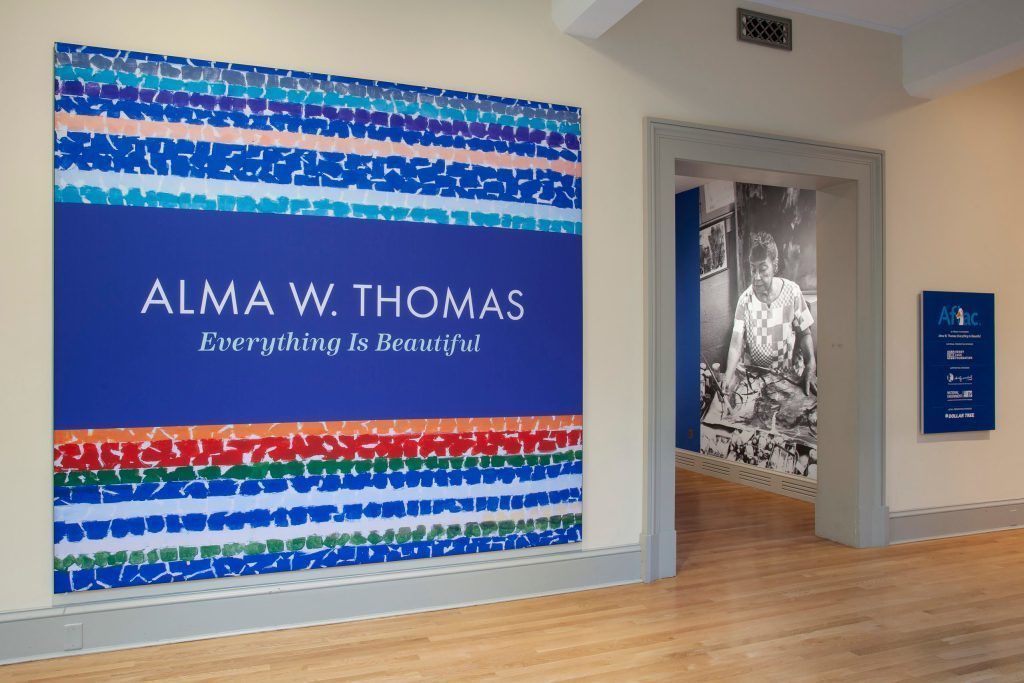
Two Columbus Legacies: Alma Thomas and Lamar Baker
November 14, 2004 - February 27, 2005

Two Columbus Legacies pays tribute to the artistic achievements of Georgia natives Alma Thomas (1891-1978) and Lamar Baker (1908-1994). The exhibition features approximately 100 prints, drawings and paintings by the two artists that are drawn from the Columbus Museum's extensive holdings. Thomas' vibrant abstractions came to international prominence in 1972 when she became the first African-American woman to be awarded a solo exhibition at the Whitney Museum of American Art. Although influenced by earlier modern masters such as Matisse and Picasso, her work was perhaps more shaped by her fascination with the optical effects of pure color and with natural forms, especially flowers. Baker achieved national recognition for his socially and politically-charged prints, many of which depict African-American life in the South. The artist's images reflect his keen interest in gospel music as well as folk art and surrealism. This exhibition was made possible by generous funding from The Fifth Generation Foundation. The works by Alma Thomas are a gift of Miss John Maurice Thomas in memory of her parents, John H. and Amelia W. Cantey Thomas, and her sister, Alma Woodsey Thomas.

 
Our Young Nation:
American Federal Furniture and Decorative Arts from the Watson Collection

September 19, 2004 - January 9, 2005

In the years following the American Revolution and creation of the United States in 1783, new designs for furniture and other decorative arts swept through the new nation. Based on English and European neoclassical interpretations, this new style featured colorful veneers and inlays, refined carving, geometrical shapes and an overall lightness and delicacy that contrasted with preceding styles. Drawing on more than 80 pieces of furniture and other decorative arts from the collection of Ronald Watson, this exhibition presents a comprehensive profile of furniture made in cabinetmaking centers from Boston to Charleston from the late 1780s to the 1820s. Featured in the exhibition are substantial secretary bookcases, chests, and various types of tables, chairs, looking glasses and specialty forms representing a great variety of woods and techniques. While demonstrating the high level of artistry attained by furniture-makers of the period, this selection in many ways reflects the evolving character of domestic life in America and the emergence of stylistic elements that are distinctly American. The exhibition was accompanied by a major publication, American Federal Furniture and Decorative Arts from the Watson Collection, which is on sale in the Museum Shop. The exhibition and publication were made possible through generous donations from Friends of the Museum.

 
Southern Bent
August 1, 2004 - January 30, 2005

Southern Bent is a traveling exhibition of 16 outdoor sculptures by 11 artists from the South-Robert L. Coon, Rudy Rudisill, Loren Schwerd, Carl Billingsley, Mark E. Brown, Robbie Barber, Greg Shelnutt, Dawn Stetzel, Anne Stoddard, Sandy Willcox and Ralph Paquin. Southern Bent is the first exhibition to bring large-scale outdoor sculpture of this size to the Columbus Museum grounds. The Museum developed a sculptural map and walking tour to accompany the exhibition. This exhibition was made possible by the Hardaway Endowment Fund and the Landrum Educational Endowment Fund.

 
Lift Every Voice: Columbus' African-American Heritage, 1870-1970
February 19, 2004 - July 10, 2005

In the century that spanned the end of slavery to the beginning of the Civil Rights movement, African-Americans created unique social institutions while contributing to the development of Columbus as a whole. Vibrant African-American communities flourished in the southeastern part of downtown Columbus and enclaves to the east and north. Yet only a few structures and historical markers remain that bear witness to the struggles and triumphs of the people who once lived there.

Lift Every Voice: Columbus’ African-American Heritage, 1870-1970 showcases the individuals and sites featured in Columbus’ Black Heritage Trail and serves as a companion piece to a video project developed by the Mayor’s Commission on Diversity, under the direction of archivist and historian, Dr. Craig Lloyd. Among the individuals represented are: structural engineer Horace King; “Mother of the Blues” Ma Rainey (Gertrude Pridgett); artist Alma Thomas; aviator Eugene Bullard; scholar John Henrik Clarke; educator William H. Spencer; minister and barber Primus King; civil rights activist Dr. Thomas Brewer; and Mayor Pro Tem A.J. McClung. This exhibition was made possible, in part, by the City of Columbus, through a grant to the Columbus Cultural Arts Alliance of the Greater Columbus Chamber of Commerce.

 
Introductions: Marcus Kenney
August 15 - December 5, 2004

This exhibition was the first segment in a new series of exhibitions that will be devoted to new and recent work by the best emerging artists from Georgia and beyond. Although Marcus Kenney often refers to his works as "paintings," they are in fact intricately crafted collages made up of discarded debris such as wallpaper, fabric, linoleum, letters and newspaper, among other media. Some pieces are largely abstract whereas others contain figurative elements injected with social commentary referencing topics such as consumerism, racism and the environment. This exhibition was made possible by the Hardaway Endowment Fund.
 
Out of the Woods: Turned Wood by American Craftsmen
June 20 - October 3, 2004

Out of the Woods celebrates the ancient craft of turned wood and its emergence as a dynamic contemporary art form during the last three decades. The exhibition features 100 stellar works by some of America's finest turners, many of whom create distinctive objects that challenge popular distinctions between art and craft. Along with groundbreaking works by turning pioneers such as Ed Moulthrop, Rude Osolnik and Bob Stocksdale are those by younger artists such as Mark Lindquist, John Jordan and Stoney Lamar. While some objects are designed to reveal the inherent beauty of exotic woods, others elevate cast-off plywood and insect-damaged material into objects of surprising elegance and sculptural power. Organized by the Mobile Museum of Art, this exhibition has traveled to 15 different countries in Europe before its U.S. tour. This exhibition was drawn from the Mobile Museum of Art and from private collections. The local presentation of this exhibition was made possible by generous support from the Edward Swift Shorter Bequest Fund.
 

Redefining Georgia: Perspectivas en Arte Contemporáneo
May 2 - August 22, 2004

Redefining Georgia: Perspectivas en Arte Contemporáneo examined the work of several artists from Cuba and Latin America who now reside in Georgia. Representing one of the state's most rapidly growing constituencies, the exhibition included a broad range of objects, such as paintings, installations, sculptures, videos and collage by some of the most respected artists in Georgia. These diverse works powerfully express the artists' personal narratives, perspectives and experiences. Redefining Georgia: Perspectivas en Arte Contemporáneo was the Columbus Museum's first contemporary survey of its kind and includes artists Rocio Rodríguez, Arturo Lindsay and Mario Petrirena, among others.

The opening of Redefining Georgia: Perspectivas en Arte Contemporáneo coincided with the Museum's unveiling of new bilingual object labels and a new audio tour. This exhibition was made possible by the generosity of the following donors: The Fifth Generation Foundation; The Grassroots Arts Program which is supported in part by the Georgia Council for the Arts through an appropriation of the Georgia General Assembly; and The Edward Swift Shorter Bequest Fund.

 
Recently Acquired Drawings: Building on Strength
April 9 - August 1, 2004

Although the Columbus Museum is known for the strength of its collections in general, the American drawing collection has enjoyed particularly significant growth in recent years. In 2003, the Museum acquired the stellar drawing collection of Dr. and Mrs. Philip L. Brewer, which immediately elevated the profile of the Museum's already important holdings to the point at which they are now considered to be among the finest museum collections of American drawings in the country. Last summer this collection of more than 100 works was unveiled along with works from the Museum's existing collection in A Celebration of Creativity, an exhibition that included more than 250 key works from the colonial period to the present. Additional gifts and purchases since then continue to build upon this strength.

Recently Acquired Drawings: Building on Strength featured a selection of approximately 30 works acquired by the Museum in the last year. These unique works on paper offered intimate glimpses into the rich history of American art and provide a microcosm of the depth, range and quality of the collection as a whole. The Museum's drawing collection promises to enjoy continued development in the years to come, and will be the focus of significant attention with the publication of a major book, Lines of Discovery: American Drawings in the Columbus Museum, slated for release in spring 2006 to accompany a national touring exhibition drawn from the collection. This exhibition was made possible by the Lenora Jordan Garrard Charitable Lead Annuity Trust.
 
Tales from the Easel: American Narrative Paintings from Southeastern Museums
February 8 - April 11, 2004

This exhibition featured 70 masterpieces from the permanent collections of 28 prominent museums in the Southeastern United States. Tales from the Easel included works by some of this country's most beloved artists: Homer, Benton, Hassam, Lawrence and Wyeth. The show traveled to only four venues in the Southeast, and Columbus was the opening venue. The exhibition was organized by The Columbus Museum and The Speed Art Museum in Louisville, Kentucky.

After making its premiere at the Columbus Museum, Tales from the Easel traveled to the Tampa Art Museum. Additional venues include The Speed Art Museum and the El Paso Art Museum. Tales from the Easel was made possible by The Henry Luce Foundation, Inc. The local presentation of the exhibition was made possible by generous funding from Synovus, CB&T and TSYS.

 
Our Town: Photographs by Chip Cooper
October 12, 2003 - March 7, 2004

Our Town included 26 color photographs by a prominent area photographer who has created a photo-essay on 13 important historic buildings in and around Columbus, Georgia, and Phenix City, Alabama. An interesting feature presented especially for this exhibition was a large wall map that identified the location of each structure. Copies of the map and interpretive text for the show were also available in handout form for those who might wish to visit some of the sites.

 
Treasures: Celebrating 175 Years in the Chattahoochee Valley
September 14, 2003 - January 18, 2004

This exhibition explored the economic transformations that pushed Columbus from a frontier settlement on the banks of the Chattahoochee River to a thriving industrial and regional center. Visitors were able to witness how those changes affected people's lives in the 19th and 20th centuries. A variety of newly-acquired historical objects, antique clothing, historic photographs and original documents were on display. There were also special areas for hands-on exploration. Please be sure to visit www.columbusmuseum.com/treasures to learn more about this exciting exhibition. This exhibition was made possible by generous funding from MeadWestvaco.

 
Our World Observed: Photographs from the Permanent Collection
October 12, 2003 - January 4, 2004

The Columbus Museum has a rich and growing photography collection, which documents people, places and realities, both concrete and imagined. This exhibition provided the first opportunity to present a comprehensive assessment of this small, but significant aspect of the Museum's permanent collection. This exhibition was made possible by generous funding from The Hardaway Endowment Fund.

 
The Art and Craft of Gunsmithing:
Historical Firearms from the C. Dexter Jordan, Sr., Collection

December 1, 2002 - November 30, 2003

This exhibition showcased a sample of significant and unusual pieces from an extensive weaponry collection donated by C. Dexter Jordan, Sr., between 1960 and 1985. C. Dexter Jordan, Sr., was a supporter of the Columbus Museum from its inception until his death in 1985. Jordan's interests in collecting firearms covered every aspect of the field, from handguns to flare guns; flintlock muskets to machine guns; and powder flasks to bullet molds. More focused interests were handguns, repeating rifles and Civil War weaponry. For this exhibition, the Museum's curators selected pieces that highlighted the art and craft of weapons making and decoration. The Art and Craft of Gunsmithing was made possible by generous support from the Edward Swift Shorter Bequest Fund.

 
A Celebration of Creativity: Three Centuries of American Masterworks on Paper
May 11 - August 31, 2003

This major exhibition was part of the Museum's 50th Anniversary and presented for the first time a comprehensive review of American drawings from the Museum's permanent collection. Almost 250 drawings from the Museum's exceptional collection of American drawings, watercolors and monotypes were on view. The unique works on paper dated from the late 18th up to the 21st century. Many of the exhibited sheets have been acquired by the Museum in the last five years and had never been shown. Among the selections were works by Milton Avery, Thomas Cole, John Singleton Copley, Nancy Grossman, Marsden Hartley, Malvina Hoffman, William Trost Richards, John Singer Sargent, Andrew Wyeth and Marguerite Zorach, among many others. Brilliant drawings by Thomas Hart Benton, Jay DeFeo, Childe Hassam, Winslow Homer, Robert Motherwell and Louise Nevelson added to this wonderful assembly. Themes of figuration, nature and abstraction provided for interesting visual exploration. This exhibition was made possible by generous support from Aflac.

 
Heartland: Paintings and Drawings by Bo Bartlett, 1978-2002
January 26 - April 20, 2003

Bo Bartlett evokes the underlying epic nature of what at first glance may appear commonplace, and, on the other hand, makes extraordinary events very personal. He uses a community of friends, family, personal experiences and interactions for his subjects, and he sees the smallest details as significant in the finished work. Whether his paintings are monumental or intimate, the term "heartland" genuinely reflects their greater correlation with an American identity. Both the lavishly produced book and the exhibition that bears the name Heartland celebrate that connection.

Major funding for this exhibition and catalog was made possible by friends in Columbus, Georgia: to celebrate the spirit of the Columbus Challenge - a dynamic partnership between the citizens of Columbus, its city government, and the State of Georgia - which raised $94 million to ensure that the cultural arts will forever be the heartbeat of this vital community located on the banks of the Chattahoochee River; and to honor the remarkable talent of Bo Bartlett, a native son of Columbus. Following the Columbus exhibition, the exhibition traveled to Greenville, South Carolina; Seattle, Washington; Santa Barbara, California; and Philadelphia, Pennsylvania.


Wedding Gowns of a Golden Age,
1885-1930

October 22, 2006 – May 13, 2007

This exhibition features a selection of wedding gowns and related accessories—slippers, wedding announcements, wedding gifts, jewelry, portraits, etc.—from the late 19th and early 20th century. Most items are linked to families from the Columbus area and have never been on public view. Together, the objects offer a unique look at 19th and early 20th century wedding etiquette and the influence of tradition.


Sarah Hobbs’ Untitled (Indecisiveness)
July 10, 2006 – April 8, 2007  

The Museum’s Discovery Gallery on the upper level is devoted to exploring in depth a single work of art from the permanent collection. On July 10, a new Discovery Gallery installation opened featuring a large color photograph by Atlanta artist Sarah Hobbs, which was acquired last year. The print, Untitled (Indecisiveness), represents Hobbs’ interest in phobias and obsessive compulsive behavior. The Discovery Gallery installation offers viewers an opportunity to see images of other works by Hobbs, read books on artists who influenced her work, respond to key questions raised in Hobbs’ images, and even explore a life-sized re-creation of the room depicted in Untitled (Indecisiveness).


Introductions: Angela West
October 20, 2006 – March 4, 2007

In her large color photographs, emerging Georgia artist Angela West seeks to reveal the extraordinary among the ordinary. The Dahlonega native has focused her lens on her hometown in order to create several series, four of which are highlighted: Sweet Sixteen, Corsages, Familiar Landscapes and My 33rd Spring. Sweet Sixteen presents revealing portraits of contemporary female adolescence, whereas Corsages consists of poetic, backlit images of prom corsages that West transforms into expressive still lifes. In Familiar Landscapes and My 33rd Spring, she depicts the grassy lawns and winding streets of her neighborhood as elegant, intriguing vistas. West’s work has begun to receive national attention and is included in the collections of the High Museum of Art in Atlanta, Georgia, The Ogden Museum of Southern Art in New Orleans, Lousiana and the Hirshhorn Museum in Washington, D.C.

The Chattahoochee: A River of History
August 13, 2006 – February 11, 2007

For centuries, the Chattahoochee River has served residents of this area as a transportation route, engine for commerce and recreational resource. A vital part of our community’s past, present, and future, it binds the Chattahoochee Valley together as a region. Through photographs, postcards and paintings, this exhibition will take a look at how the river has helped shape the development of the Chattahoochee Valley.

Enjoy this exhibition with kids, using the Family Guide for this exhibition! This exhibition was made possible by generous support from Eagle and Phenix Mills.

Ansel Adams: Celebration of Genius
October 1, 2006 – January 7, 2007

Ansel Adams: Celebration of Genius includes 150 landscapes, intimate still lifes of nature, and portraits by one of the most celebrated photographers in American history. Adams (1902-1984) produced breathtaking black and white images of national parks and other landmarks that have become landscape icons of the American West. The selections are drawn from the holdings of the George Eastman House and include photographs from his early groundbreaking work of the 1920s through the masterful and equally inspired late work of the 1960s. The exhibition includes many of his most famous works, from majestic landscape scenes of the American West—including early views of Yosemite—to portraits, still lifes and abstracts.

Notably, the exhibition includes a 1927 portfolio of rare Parmelian prints (gelatin silver emulsion on parchment paper) that are among the artist’s most prized creations. Together, these important images will demonstrate the full range and depth of his legendary photographic achievements. George Eastman House owns an extensive collection of Adams’ work—270 images total—thanks in large part to the artist’s longtime friendship with Beaumont Newhall, George Eastman House’s first curator and second director. Ansel Adams: Celebration of Genius is organized by George Eastman House, curated by Jeanne Verhulst, Associate Curator of Exhibitions.

The local presentation of this exhibition was made possible by the generous support of Aflac.
New Directions in American Drawing
February 25 - June 10, 2007

American drawings of the late 18th through the mid-to-late 20th century represent one of the chief strengths of the Museum's fine art collection. To examine more recent trends in American drawing, the Museum presents New Directions in American Drawing, which will feature work by 16 artists, several of whom have yet to receive a major museum exhibition: James Barsness, Suzanne Bocanegra, Hilary Brace, Brad Brown, Ingrid Calame, Russell Crotty, Valerie Demianchuk, Leonardo Drew, Anthony Goicolea, Edgar Jerins, Julie Mehretu, Amy Myers, Robyn O'Neil, Peggy Preheim, Jane South and Lee Walton. The exhibition will be accompanied by an illustrated catalog and is organized by Stephen C. Wicks, the Museum's former Curator of Collections and Exhibitions.

Josef Albers: The Power of Color
June 11 – October 1, 2006

The exhibition includes a selection of serigraph prints by Josef Albers from two folios entitled Formulation: Articulation published by Harry N. Abrams in 1972. The Museum’s collection contains 66 prints from his major series including, Tectonics (1941-1942), Structural Constellations (1949-1976), Variants (1947-1955) and Homage to the Square (1950-1975).

Josef Albers (1888-1976) was one of the most influential artists and theorists of the 20th century, exploring the optical effects created by controlled combinations of colors within simple geometric forms—particularly the square. Josef Albers was educated at the Bauhaus, in Weimar, Germany, the most important school of architecture, design and art of the 20th century that removed any distinction between fine art and craft. In the mid 1930s, shortly after the Bauhaus was forced to close by the Nazis, Albers immigrated to the United States. He spent the next 16 years teaching at Black Mountain College in North Carolina, an experimental school that integrated fine art in all learning. In 1950, Albers became the Chair of the Department of Design at Yale University where he continued to teach until his retirement in 1960.

.


Stitches in Time: American Quilts, 1850-1940
March 5 – September 17, 2006

Stitches in Time includes several quilts from the Museum’s permanent collection that have never before been seen. The exhibition chronicles the history of quilt patterns and styles, while emphasizing process and technique by including examples of quilting blocks in addition to other textile remnants. Highlights of the exhibition include a 19th century sewing box and stand with mother of pearl inlay, a late 19th century crazy quilt created from scraps of fabric that include an 1865 President Grant commemorative ribbon, and a Hawaiian pictorial quilt circa 1940. Stitches in Time represents nearly a century of quilt making, illustrating the variety of patterns, fabrics and colors used by quilt makers that attest to the Museum’s diverse holdings within the decorative arts collection.

Andrée Ruellan at 100
March 26 –August 27, 2006

The Columbus Museum joined with The Georgia Museum of Art in Athens and the Telfair Museum of Art in Savannah to present an exhibition in celebration of the 100th birthday of Andrée Ruellan, an American artist whose outstanding career and remarkable longevity have brought her increasing attention. The artist’s paintings, drawings and prints of American urban life reflect her heartfelt artistic response to the Depression, World War II and other key developments in the nation’s modern era. While capturing the spirit of American life, Ruellan’s distinctive works reflect her investigation of abstraction and surrealism and her uncommon ability to capture the complex nature of the human condition.

The local presentation of this exhibition was made possible by generous support from the Hardaway Endowment Fund. Andrée Ruellan at 100 was organized by the Georgia Museum of Art, University of Georgia, Athens. This program is supported in part by the Georgia Council for the Arts through the appropriations of the Georgia General Assembly. The Council is a Partner Agency of the National Endowment for the Arts. Andrée Ruellan at 100 is generously sponsored by the Landon Family Foundation and by Alfred Heber Holbrook Society members Mr. D. Jack Sawyer, Jr. and Dr. William E. Torres. Additional support is provided by the W. Newton Morris Charitable Foundation and the Friends of the Georgia Museum of Art.

William Morris: Myth, Object and the Animal
April 9 - August 20, 2006

Strongly influenced by his interest in archeology and ancient pagan cultures, Morris explores the timeless relationship between humans and their environment, evoking images from a time when man was more in tune with nature. His innovative blown glass sculptures and installations are inspired by a passion for archaeology and ancient civilizations—Egyptian, West African, Mayan, Native American—as well as his deep interest in the animal world and the relationship between humans and their environment. That relationship is referenced in works with imagery drawn from the ancient cave paintings of Lascaux, France, the bones and primitive tools of an ancient Ice Age, Egyptian funerary jars or the ceramic mastodons, bulls and other creatures unearthed from the 3,000 year-old Amlash graves of Iran.

Included in the exhibition, Artifact Panel consists of several hundred individual objects, each resembling an unearthed archaeological fragment, spanning an entire wall. Cache takes the form of a 36-foot long funerary setting placed atop a row of gleaming glass tusks. Idolos includes several regal, elaborately-clad human figures inspired by Mayan and Aztec civilizations. Finally, Man Adorned presents eleven mask-like human figures with various weapons and adornments inspired various sub-Saharan African cultures.

Born in 1957 in Carmel, California, William Morris is also considered to be one of the most gifted and daring young glass artists in America today. He originally worked as Dale Chihuly's gaffer (master glassblower) in the early 1980s at the renowned Pilchuck Glass School near Seattle, and has since maintained his own studio in the area.

Enhance your family's visit to the exhibition. Click here for the Family Guide, full of fun facts and activities for William Morris: Myth, Object and the Animal. This exhibition was made possible by generous funding from

TSYS logo Synovus logo
 

A Remedy for Every Ill:
Hatchett’s Drugstore and the Evolution of American Pharmacy

February 26 – July 16, 2006

Including a five thousand-item inventory of an early 20th century drugstore, the Stewart County Historical Commission’s Hatchett’s Drug Store Collection is a virtual time-capsule. Portions of this outstanding collection are on display for the exhibition A Remedy for Every Ill: Hatchett’s Drugstore and the Evolution of American Pharmacy, which explores the ways medicines were made and marketed in the era previous to federal regulation, as well as the developments that transformed pharmacies during the years of the store’s operation. Also included is a glimpse into the lives of the store’s owners and the small town in which they operated.

This exhibition was made possible by a grant from The Historic Chattahoochee Commission.


The Love of a Mother: Images by Mary Cassatt and Selected Artists
February 26 - May 14, 2006

The Love of a Mother focuses on the theme of motherhood and its many facets as examined by important American artists. The exhibition will include more than a dozen works in variety of media and styles and represents the first official display of Mary Cassatt’s Sara and Her Mother with the Baby (ca. 1901), a pastel acquired by the Museum in 2005. The Cassatt is accompanied by other works from the Columbus Museum’s collection as well as selected works from several area museums.

This exhibition was made possible by The Landrum Educational Endowment Fund.


Hugh Williams: The Market of Kumasi
September 23, 2005 - March 5, 2006

This exhibition showcases the work of Auburn-based artist Hugh Williams and includes a large mural, six mixed-media paintings entitled Headdress of Women of Africa, in addition to a series of photographs and sketchbooks. This body of work was inspired by a trip to West Africa in 1991 at which time the artist received a Fulbright-Hays educational grant. The paintings explore African culture reflecting the vibrancy of colors and energy found specifically at the marketplace. The artist further examines the role and reinterpretation of industrialized materials in such areas as body adornment through his use of found objects. Hugh Williams is Alumni Professor Emeritus of Arts at Auburn University and obtained a M.A. from Teacher’s College at Columbia University.

Enhance your family's visit to the exhibition. Click here for the Family Guide, full of fun facts and activities for Hugh Williams: The Market of Kumasi. This exhibition was made possible by the Hardaway Endowment Fund and gifts from Friends of Hugh Williams.


Introductions: George Long
September 2, 2005 - January 22, 2006

This exhibition is the second segment in a new series of exhibitions entitled Introductions that is devoted to recent work by the best emerging artists from Georgia and beyond. The exhibition features a series of 8 x 8 inch mixed-media squares by Roswell-based artist George Long which were inspired by his grandmothers’quilts both for their construction technique and narrative quality. Displayed as a group, 8 x 8 shares a narrative expressed through metaphors which expose the things people do emotionally and psychologically, while at times poking fun at human nature.

This exhibition was made possible by support from the Edward Swift Shorter Bequest Fund.


Heroes, Villains, and Ordinary Folks: Phenix City in the 1950s
August 7, 2005 - February 5, 2006

Coinciding with the 50th anniversary of Phenix City's designation as an "All-America City," this exhibition examines the myths and realities of life in the town during the turbulent era of the 1950s. Inspired by Phenix City native Jim Cannon's rich collection of photographs from the time period, the exhibition provides a snapshot of life in the town dubbed "the wickedest city in America" for its notoriety as a crime haven. The events surrounding the infamous murder of Attorney General nominee Albert Patterson are chronicled alongside seldom-seen images of everyday life and the personal reminiscences of those who lived there.

This exhibition was made possible by funding from Cable TV of East Alabama.


Made in Columbus
July 10, 2005 - January 29, 2006

Founded as a trading town and for many years one of the southernmost manufacturing cities in the nation, Columbus has a vibrant and intriguing industrial legacy than spans over 175 years. Local industries, producing items ranging from cotton gins and cannons to cola and candy, have played a vital role in the city's economic development and helped form its historical identity.

In this exhibition, the Columbus Museum celebrates part of the city's heritage. Through this series, the Museum hopes to give visitors both an entertaining look into Columbus' corporate history and a new appreciation of the importance of that aspect of the city's past. The first installment of the series features products, advertising materials, and images of a few of the most prominent businesses that have called Columbus home, such as Tom's Foods, the Royal Crown Cola Company, the Columbus Ironworks, Lummus Industries and the Alex Mitchell Candy Store. Also included is a special section chronicling the 125 year history of BellSouth in Columbus.

This exhibition was made possible by generous funding from Bill Heard Chevrolet and Bill Heard Cadillac/Saab.


King Bridge Biennial
July 17 - October 23, 2005

King Bridge Biennial highlights some of the region's top talent in Georgia and Alabama and includes work by artists Monica Cook, E.K. Huckaby, Kathryn Jill Johnson, Sang-Wook Lee, Christopher McNulty, Trish Ramsay and Kathryn Refi. Each artist showcases a body of work in a variety of media, including painting, mixed-media, sculpture and installation. A catalogue accompanies the exhibition.

The King Bridge Biennial calls attention to Horace King and the first bridge King built across the Chattahoochee River in 1832, connecting Columbus to Phenix City (then known as Girard), Alabama. The covered bridge spanning 560-feet in length was a vital component to the region's development. Today, the modern Horace King Bridge continues to serve as a physical and metaphorical link between Georgia and Alabama (the two states represented in this exhibition series), as it connects the multicultural identities of these two vital Southern states.

This exhibition was made possible by the Edward Swift Shorter Bequest Fund.


Wayne Kline and the Rolling Stone Press
June 5 - August 21, 2005

In 1984, Wayne Kline founded Rolling Stone Press, the first and only professional lithography studio in Atlanta. As a Master Tamarind Printer, a distinction awarded to only 100 individuals since its inception in 1960, Kline's interest in lithography is both an educational and artistic endeavor. The exhibition Wayne Kline and the Rolling Stone Press highlights a selection of prints from the permanent collection by such artists as Cheryl Goldsleger, Reverend Howard Finster and Stephanie Jackson, attesting to Kline's interest and success in achieving multiple effects through the medium. This exhibition was made possible by the J. DuPont Kirven, Jr. Charitable Lead Unitrust.

 
Passionate Observer: Eudora Welty among Artists of the Thirties
May 29 - August 14, 2005

This provocative exhibition features more than 100 photographs, paintings, drawings and prints by notable American artists of the 1930s. At the center are Eudora Welty's dramatic photographs of Mississippi, Louisiana and New York during the Great Depression. Welty (1909-2001), who won the Pulitzer Prize in 1973 for The Optimist's Daughter, is widely considered to be one of the most eloquent Southern voices of the 20th century. Both a sensitive observer of the world and a passionate image maker, Welty was a visual artist who used the camera much like she used language when working as a writer. Although her photographs were made during a period of widespread economic instability, and often great personal despair, they attest to Welty's optimism about the human spirit and pride in her region.
Local presentation of this exhibition was made possible by generous donations from the following women of Columbus: Catherine Z. Bickerstaff, Mary B. Bradley, Helen J. Burgin, Susan M. Cochran, Sally Q. Gates, Betty G. Graham, Kathleen M. Hohlstein, Robbie K. Holt, Melinda M. Hunter, Helen L. Jackson, Betsy T.